JR West’s Hokuriku Main Line runs from Maibara Station in Shiga Prefecture toward Tsuruga Station in Fukui Prefecture. Beyond Tsuruga, the conventional railway sections toward Fukui and Ishikawa are operated by Hapi-Line Fukui and IR Ishikawa Railway. For most long-distance JR travel from Kyoto to Fukui, Kanazawa and Toyama, the practical route is to take the Thunderbird Limited Express to Tsuruga and transfer there to the Hokuriku Shinkansen.
Thunderbird and Hokuriku Shinkansen route overview
The Thunderbird Limited Express is a JR West limited express that links Osaka Station, Shin-Osaka Station and Kyoto Station with Tsuruga Station. On Kyoto Station signage this route is referred to as the Hokuriku Line, but the train actually follows the JR Kyoto Line, then the Kosei Line, before joining the Hokuriku Main Line proper at Tsuruga Station. At Tsuruga, passengers for Echizen-Takefu, Fukui, Awara Onsen, Kaga Onsen, Komatsu, Kanazawa, Shin-Takaoka and Toyama transfer to the Hokuriku Shinkansen. The Tsurugi Shinkansen is the main regional connection between Tsuruga and Kanazawa or Toyama.
The Japan Rail Pass covers eligible JR travel on the Thunderbird and Hokuriku Shinkansen, subject to the seat class and reservation rules for the pass. Gran Class and some non-JR local railway sections may require extra payment. Thunderbird ordinary cars are reserved-seat cars, so reserve a seat before boarding. At Kyoto Station, check the departure boards and ticket gate displays for the train’s platform and final destination.
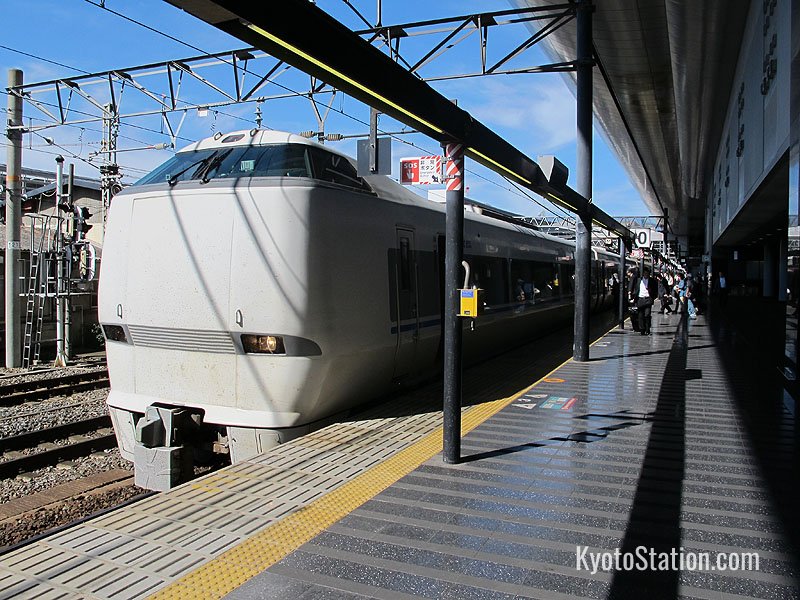
A Thunderbird Limited Express train. After the 16-Mar-2024 timetable revision, regular Thunderbird services from Kyoto run to Tsuruga.
Key Destinations
The Thunderbird Limited Express and Hokuriku Shinkansen connection is a convenient and fast route for popular tourist destinations in Fukui Prefecture, Ishikawa Prefecture and Toyama Prefecture. From Kyoto, take the Thunderbird to Tsuruga and change to the Hokuriku Shinkansen for stations farther north.
Fares and journey times from Kyoto vary by departure time, Tsuruga connection, train type and seat type. Use the JR West Timetable & Route Finder for the latest route, fare and schedule before travel.
The following stations are the locations you are most likely to visit en route.
Tsuruga Station
Tsuruga is a port city in Fukui Prefecture and the transfer station between the Thunderbird Limited Express and the Hokuriku Shinkansen. Its major sites are the massive gate of Kehi Shrine, the garden of Saifukuji Temple, the white sand beach and pine trees of Kehi no Matsubara, and the Meiji era red brick warehouses near Tsuruga Museum.
Echizen-Takefu / Takefu
For Echizen city, passengers from Kyoto transfer at Tsuruga to the Hokuriku Shinkansen for Echizen-Takefu Station. Conventional Takefu Station is served by Hapi-Line Fukui. Echizen has many historic buildings, shrines and temples, but it is most famous for its crafts and its cuisine. You can get hands on experience with Echizen ceramics at the Echizen Pottery Village. At Echizen Washi no Sato you can learn about traditional papermaking. And the Echizen Soba Center is just one of many locations serving up the city’s famous noodles.
Fukui Station
Fukui is the capital city of Fukui Prefecture. Its famous sites are the Ichijodani ruins (a partially reconstructed 15th century castle town), the Zen temple complex of Eiheiji Temple, and, in the spring, the 600 cherry trees that line the Asuwa River.
Awara Onsen Station
The city of Awara is famous as a hot spring resort. Check the official Awara City website for sightseeing, lodging and access information.
Kaga Onsen Station
Kaga is a large sprawling city that includes within its official boundaries many smaller towns, among them the famed hot spring resorts of Awazu, Yamashiro, Yamanaka, and Katayamazu. Natadera Temple is also a short bus ride from Kaga Onsen Station and is worth a visit for its gardens and its commanding views of Mount Hakusan.
Kanazawa Station
Kanazawa’s major tourist locations include, the partially reconstructed Kanazawa Castle, Miyoryuji Temple (also called the Ninja Temple) which has many secret passages and trap doors, the traditional teahouses of the Higashi Chaya geisha district, and Kenrokuen garden, which is said to be one of the three great gardens of Japan.
Passengers from Kyoto normally take the Thunderbird to Tsuruga and change there to the Hokuriku Shinkansen for Kanazawa. If you are heading onward to Wakura Onsen, change at Kanazawa to the Noto Kagaribi or Nanao Line services. Passengers heading for Toyama should stay on the Hokuriku Shinkansen from Tsuruga.
Wakura Onsen Station
Wakura Onsen is a 1200 year old luxury hot spring resort on the tip of the Noto Hanto peninsula. The baths here, overlooking the sea, are said to have many health benefits. From Kyoto, take the Thunderbird to Tsuruga, transfer to the Hokuriku Shinkansen for Kanazawa, and then change to the Noto Kagaribi or Nanao Line services for Wakura Onsen. Check the official Wakura Onsen site for lodging, sightseeing and access status before travel.
Toyama Station
Toyama is the capital city of Toyama Prefecture. Its most popular tourist attractions are Toyama Castle and boat trips on the Matsukawa River. The city is also within striking distance of hiking routes along the Tateyama Mountain Range. From Kyoto, take the Thunderbird to Tsuruga and transfer there to the Hokuriku Shinkansen for Toyama.
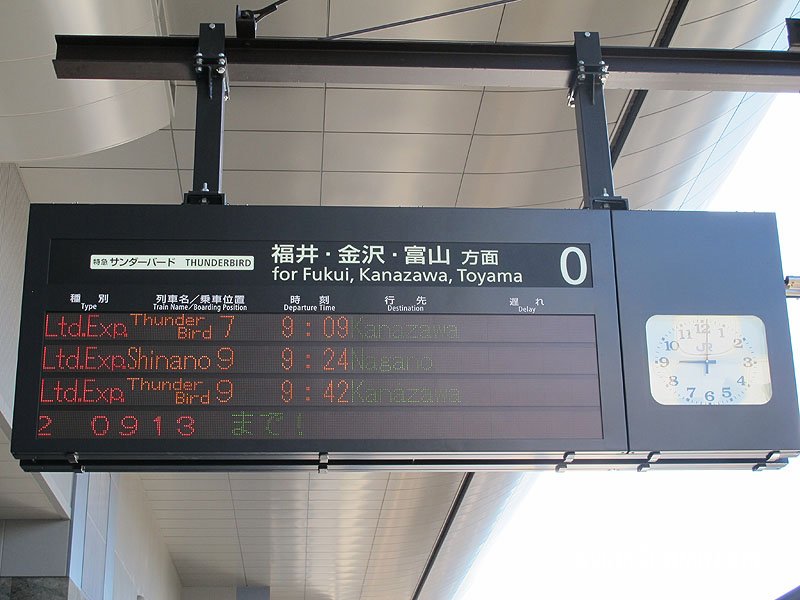
Check your Tsuruga and Kanazawa transfers before traveling to Wakura Onsen.
Useful Links
If you don’t have a Japan Rail Pass, you might consider investing in a Kansai-Hokuriku Area Pass for travel from Kansai to Toyama, Ishikawa and Fukui, including reserved seats on the Hokuriku Shinkansen within the pass area and limited express trains such as the Thunderbird. The Hokuriku Area Pass is a shorter pass for travel within Toyama, Ishikawa and Fukui.
To find departure times quickly and easily use the JR West Timetable & Route Finder.
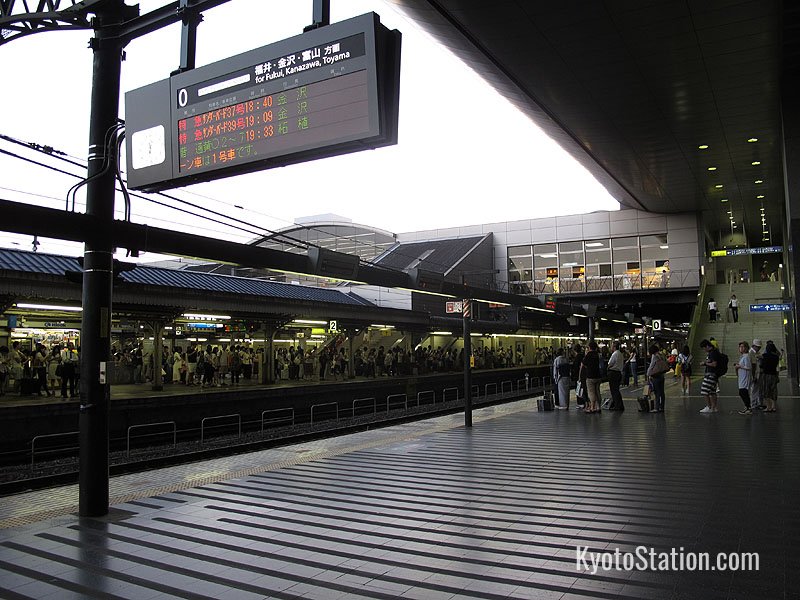
Check Kyoto Station departure boards for the Thunderbird Limited Express platform.
Article and photos by Michael Lambe. All rights reserved. Last updated 18-Jun-2026.